I've been working with an AI assistant every day for a month now. Not experimenting with it. Actually relying on it for real work.
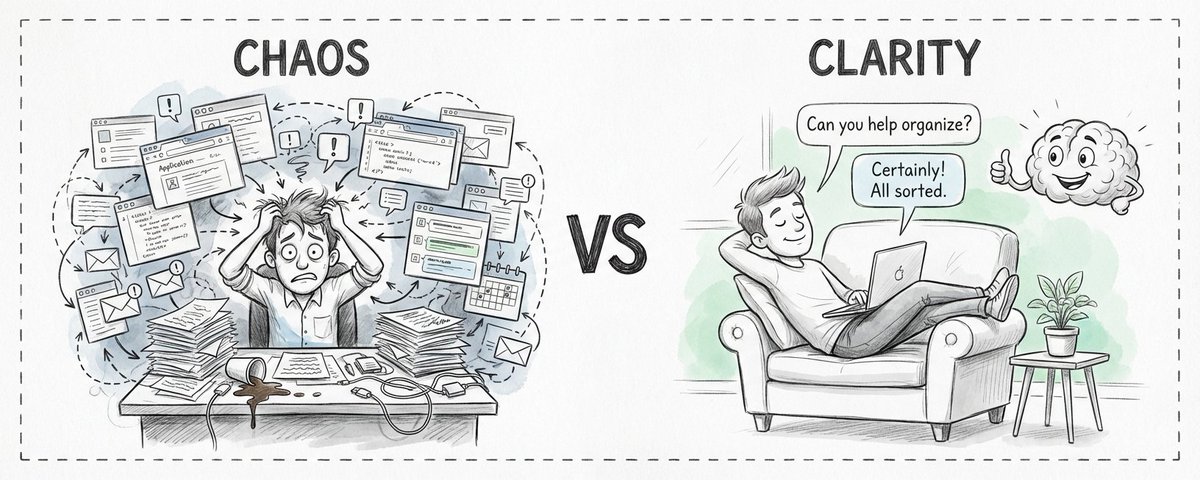
The biggest thing I've noticed isn't about the AI. It's about me. About how I think when I sit down to get something done. I realized I have this habit I'm calling "SaaS brain" and it was getting in my way.
SaaS brain
You know that thing where you need to do something and your first thought is "which app do I open?". That's a SaaS brain.
You need to create a issue, so you open Linear, find the right board, click New, fill out six fields, save. You need to write something, so you open Notion, draft, get feedback in comments, copy it somewhere else, format it again. Everything starts with navigating to the right screen in the right tool.
We've been trained this way. A decade of software taught us to think in buttons and menus. "I need X" turns into "where's the button for X" and that feels so normal we don't even notice it anymore.
But it's slow. You're spending half your energy just getting to the place where work happens.
Assistant brain
Assistant brain skips all of that. Instead of "which app do I open," it's just "what do I want done."
I needed tickets created from a set of meeting notes. So I said that. Fifteen tickets showed up in Linear in my project board, properly labeled and assigned. I would have never added that many details 🙈
I write release notes almost every day, so I have my assistant read the repo every day at 6pm, if there’s a release it writes the notes, runs them by me for approval and then pushes a PR to our repo.
I needed a test dashboard, a simplified version of TestRail. I described what I wanted. A few minutes later I had a live URL with 40+ test cases loaded in.
None of this required me to navigate anywhere. I just said what I needed and it happened.
Where I kept tripping up
This switch didn't happen overnight. I kept catching myself in SaaS mode.
I'd say things like "can you open the analytics page" instead of just asking "how did last week go." I was treating the assistant like a remote control for apps instead of just... talking to it.
Or I'd give absurdly specific instructions. "Go to this file, line 47, change this value." When I could've just said "update Carson's title, he's team lead now." I was doing all the thinking and asking it to type. That's not collaboration, that's dictation.
The worst one: when it got something wrong, my gut reaction was to throw it out and do it myself. That's pure SaaS reflex. The tool broke, switch tools. But with an assistant, the better move is to say what was wrong. Because every correction makes the next time better. With SaaS, your feedback disappears into bunch of support tickets that never get resolved. With an assistant, it actually learns and gets better over time.
The setup is the whole point
People expect an assistant to be great immediately. Like downloading a new app. Sign up, log in, instant value.
Nope.
An assistant on day one is mid (like a toddler that learns how to properly talk). An assistant on day twenty is a different story. By then it knows your writing style, your team, your preferences, the way you like things structured. It knows that "prep for standup" means check the board, pull yesterday's work, and draft bullet points. I didn’t stup that in a settings page. It learned from working with me.
I watched mine go from generic and kind of stiff to genuinely good. Not because of some software update. Because we worked together enough that it picked up how I think. That's not something you get from any SaaS tool no matter how much you pay for it.
What actually changes
A few things surprised me once I made the switch:
- You stop context-switching. The assistant moves between tools, not you. You stay in one conversation.
- Your taste becomes your biggest asset. The most useful thing you can give an assistant isn't instructions. It's your judgment. What good looks like. How you talk. What matters. SaaS never cared about that.
- It compounds. Every interaction makes the next one faster. After a few weeks you stop explaining things. It just knows.
- You become a director instead of an operator. You still make every call. You just stop clicking through five apps to execute on it.
This is a small shift with big consequences
I'm not saying throw out all your software. Some tools are still fine. The problem is the habit of thinking you need to navigate to a screen before anything can happen.
An assistant doesn't replace your tools. It removes you from the tedious parts. You still need a project board, a repo, a CMS. You just stop being the one clicking through them.
It's a quiet shift. No migration, no new onboarding flow. Just a change in how you think about getting things done. But once you feel the difference, going back feels like dial-up.